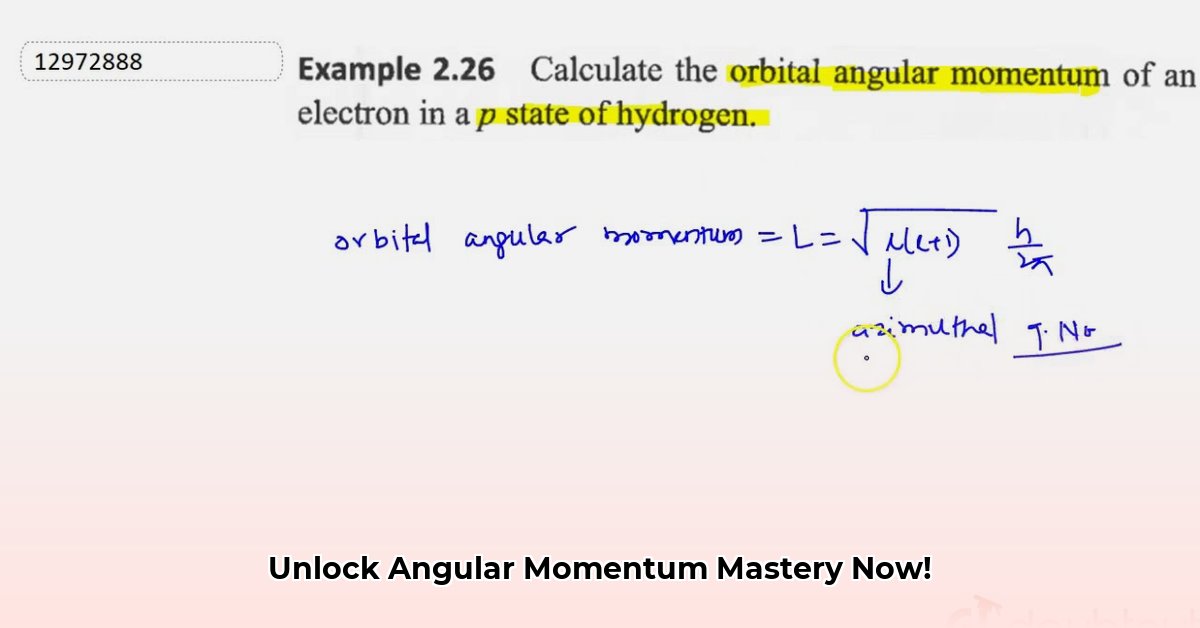
Angular Momentum Calculator: Your Key to Understanding Spinning Objects
Ever wondered why figure skaters spin faster when they pull their arms in? Or how a spinning top maintains its upright position? The answer lies in angular momentum – a concept describing the rotational motion of objects. It's analogous to linear momentum (think of a bowling ball rolling), but for spinning objects. Let's explore this fascinating physics concept. Understanding angular momentum is crucial in many fields, from aerospace engineering to astrophysics. Are you ready to master it?
What Exactly is Angular Momentum?
Angular momentum (often denoted as 'L') quantifies an object's resistance to changes in its rotation. It depends on two key factors: the distribution of the object's mass and its rotational speed. A larger, more spread-out mass or a faster spin rate results in greater angular momentum. Consider a spinning top and a slowly rotating merry-go-round: both possess angular momentum, but the amounts differ significantly due to variations in mass distribution and rotational speed. How can we calculate this pivotal quantity?
Calculating Angular Momentum: Two Key Scenarios
Calculating angular momentum differs depending on the object. We use two primary formulas:
Point Mass: For a single object spinning in a circle (like a small marble on a string), the formula is simple: L = mvr. 'm' represents mass (in kilograms), 'v' is its linear speed (meters per second), and 'r' is the radius of the circle (meters).
Rigid Body: For more complex objects (like a spinning wheel or planet), we use L = Iω. 'ω' (omega) is the angular velocity (radians per second), and 'I' is the moment of inertia – a measure of how difficult it is to change the object's rotation. This depends on the object's shape and mass distribution. A solid cylinder, for example, has a different moment of inertia than a hollow cylinder of the same mass.
Fortunately, angular momentum calculators simplify these calculations.
Using an Angular Momentum Calculator: A Step-by-Step Guide
Numerous free online calculators streamline this process. Here's a step-by-step guide:
Step 1: Object Identification: Determine if your object is a point mass or a rigid body. This step dictates the appropriate formula used in the calculation.
Step 2: Data Gathering: Collect necessary information: mass, speed, radius (for point masses), moment of inertia, and angular velocity (for rigid bodies). Use consistent units (kilograms, meters, seconds, radians). Failing to use consistent units is a common source of error.
Step 3: Value Input: Enter your data into the calculator. Most calculators have straightforward instructions and input fields. Double-check your inputs for accuracy before proceeding.
Step 4: Calculation: Click "calculate." The calculator computes the angular momentum's magnitude (size). Remember that angular momentum is a vector quantity; it possesses both magnitude and direction.
Step 5: Result Interpretation: Analyze the calculated value within the problem's context. Does the result align with expectations? A higher angular momentum suggests the object is harder to stop spinning than one with a lower angular momentum.
Understanding Moment of Inertia: The Key to Rigid Bodies
The moment of inertia (I) is critical for calculating the angular momentum of rigid bodies. It depends not only on the object's total mass but also on how this mass is distributed around the axis of rotation (the imaginary line around which the body spins). The farther the mass is from the axis of rotation, the harder it is to change the rotation, resulting in a larger moment of inertia. Angular momentum calculators automatically incorporate this complexity. Did you know that even seemingly simple objects can have surprisingly complex moments of inertia?
Applications of Angular Momentum: A Wide-Ranging Concept
Angular momentum's importance extends far beyond theoretical physics. It finds crucial applications in:
Aerospace Engineering: Maintaining the stable orientation of satellites and aircraft in space. Precise control of angular momentum is essential for satellite stability.
Robotics: Controlling robot arm movements and ensuring robot balance. This ensures accurate and controlled robot actions.
Astrophysics: Understanding planetary motion around stars, including orbital dynamics and stability. It is fundamental to our understanding of planetary systems.
These fields demonstrate the vital role angular momentum plays in various scientific and engineering disciplines.
Limitations of Angular Momentum Calculators: A Word of Caution
Despite their utility, calculators have limitations:
Simplified Models: Calculators often work with idealized conditions, such as perfectly rigid objects or uniform mass distributions. Real-world objects rarely meet these perfect conditions.
Lack of Conceptual Understanding: Calculators provide numerical results but cannot substitute for a deep understanding of the underlying physics. Always strive to understand the physical principles at play. This will allow you to identify when the calculator's simplification may not be valid.
Complex Systems: Calculators struggle with highly complex systems involving multiple interacting bodies or non-uniform objects.
Always review calculator outputs critically, understanding the assumptions made in the simplification.
Conclusion: Mastering Angular Momentum
This guide empowers you to effectively use angular momentum calculations. While angular momentum calculators are invaluable tools, remember they’re just tools. A solid grasp of the underlying principles is crucial for fully understanding rotational motion. Utilize calculators wisely to enhance your understanding of the world around you! By mastering angular momentum calculations, you gain a deeper understanding of fundamental physics principles and their diverse applications.